

P. E. An, S.M. Smith, L.K. Shay, H. Peters, J.C. Van Leer, A.J. Mariano
4-D Ocean Currents Detected
by Surface Current Radar and AUVs.
web presentation or
MS PowerPoint.
Goal
Objectives
Work Plan
Mixed Layer Experiment
Tidal Experiment
Bottom Boundary Layer Experiment
DATA
Adverse Weather Experiment 2000
The goal of the proposed study is to understand the role of small-scale physical processes in the coastal ocean through observations of the four-dimensional current variability. The approach combines the FAU Autonomous Underwater Vehicle (AUV) technology with the UM Ocean Surface Current Radar (OSCR). The engineering part of the proposed research seeks to develop, integrate and test instrumentation designed to measure and characterize the subsurface current structure from AUVs and moorings. The working scientific hypothesis is that subsurface and surface currents are dynamically linked through the internal wave continuum within a four-dimensional physical environment, which can be reconstructed by integrating AUV, OSCR, shipboard and moored observations.
Top
Objectives
Specific engineering-related and scientific objectives are:
Work Plan
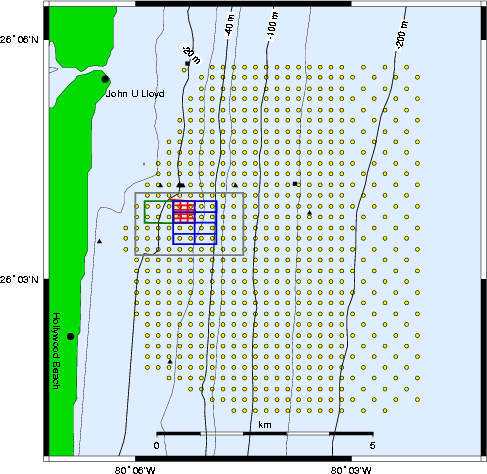
Over a period of about five weeks (21 June - 31 July 99), the experiment will require OSCR (VHF Mode) to map surface currents over a 6 km x 12 km area that oversees the USF/NOVA surface and subsurface moorings, UM cyclesonde mooring, Autonomous Underwater Vehicles (AUV) from FAU, and ship-based measurements acquired within the US Navy's South Florida Testing Facility range under the auspices of the South Florida Ocean Measurements Center range. The approximate speed of the AUVs should be about 1 - 1.2 m s-1 . These data will be combined to address the goal and objectives described above as well as contribute to other funded programs by ONR.
Top
Exp 1: Mixed Layer experiment
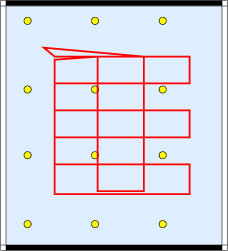
AUVs will be deployed in shallow water ranging from depths of 20-35 m and will map subsurface velocities over an approximate 500 m x 500 m box (9 OSCR grid Cells). The AUV will be at an depth of about 9-10 m, and will be equipped with upward and downward looking ADCPs and a CTD (Note downward-looking ADCP has 1-1.5 m bins, upward-looking ADCP 0.5 m bins ). For the 12 hr period, the AUVs will measure the temperature, salinity, and velocity structure with cross-shelf transects separated by 50-100 m, with a positional accuracy of 25-50 m. The intent is to conduct such measurements under relatively calm conditions. The research plan requires at least one of these missions over the 5-week deployment period.
Top
Exp 2: Tidal Current Experiment
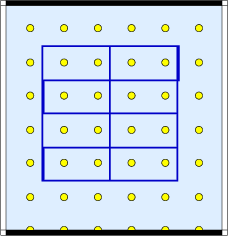
AUVs will be deployed in shallow water ranging from depths of 20-35 m and will map subsurface velocities over an approximate 1250 m x 1250 m box (36 OSCR grid Cells). The AUV will be at a depth of about 9-10 m, and will be equipped with upward and downward looking ADCPs and a CTD. For the 24-hr period, the AUVs will measure the temperature, salinity, and velocity structure with transects separated by 250 m (1 OSCR Cell), with an accuracy in the position to within 100 m. The pattern should be repeated at about 2 hr intervals over a twenty-four hour mission. The research plan requires this to be done four times over the 5- week period and will be labeled a,b,c,d .
Top
Exp 3: Bottom Boundary Layer Experiment
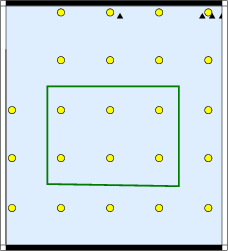
AUVs will be at an altitude of about 8 m, and will be equipped with upward and downward looking ADCPs (note upward-looking ADCP has 1-1.5 m bins, downward-looking ADCP has 0.5 m bins ) and a CTD. For the 12 hr period, the AUVs will measure the temperature, salinity, and velocity structure along repeated cross-shelf transects of 1500 m lengths at 1-2 hr intervals separated by 500 m. This mission will encompass 12-16 OSCR cells. At the end of each transect, it is desirable to profile the AUV to the surface. Note that the transects will incorporate part of the AUV-measurement domains described above in 3.1 and 3.2 encompassing several OSCR cells. The accuracy in the position is 25-50 m. The research plan requires at least one of these missions over the 5-week deployment period.
Top
Optional Experiment: Turbulent Mixed Layer
(In collaboration with Dhanak)
This optional mission would be during AUV operations under adverse weather conditions defined by winds of up to 10 m s-1 and significant waves of 2 m or less that would include turbulence measurements on the AUV. This would be similar to the Experiment 1 Mission defined above and would be designated 3.1b.